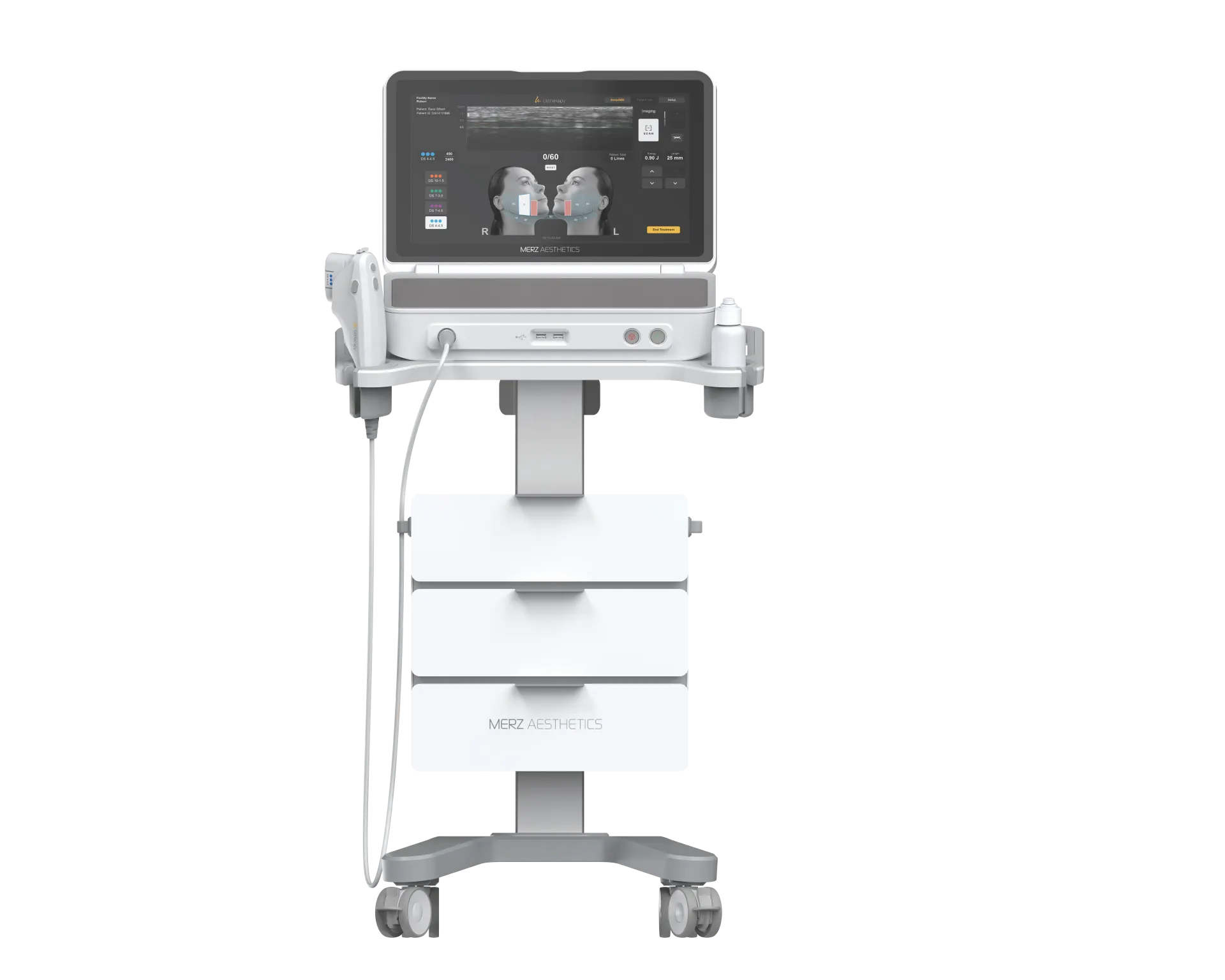
Ultherapy Prime vs Thermage FLX: Energy and Depth Differences
Ultherapy Prime uses micro-focused ultrasound with visualization (MFU-V) to target tissue at 1.5mm, 3.0mm, and 4.5mm depths. The deepest transducer reaches the SMAS layer, the same fibromuscular plane surgeons manipulate during surgical facelifts. This enables structural lifting that begins with immediate collagen contraction and continues through neocollagenesis over 2-3 months. Thermage FLX employs monopolar radiofrequency that heats the dermis volumetrically between 2-4mm without isolating a single tissue plane, producing broad tightening rather than focused lifting.
Session duration separates the two devices significantly. Ultherapy Prime full-face protocols take 60-90 minutes for 300-530 shots delivered line by line with real-time ultrasound imaging. Thermage FLX completes a 600-shot full-face treatment in 30-45 minutes using the AccuREP vibration system that reduces per-pulse discomfort. Patients prioritizing speed and comfort tolerance gravitate toward Thermage, while those requiring maximum lifting depth favor Ultherapy Prime.
Ultherapy Prime vs Sofwave: Targeting Precision
Sofwave employs Synchronous Ultrasound Parallel Beam (SUPERB) technology that operates exclusively at 1.5mm in the mid-dermis. This shallow focal point treats fine lines, mild laxity, and surface texture effectively but cannot reach the structural tissue layers responsible for visible sagging. Ultherapy Prime's 4.5mm transducer penetrates 3 times deeper, generating the dense collagen remodeling needed for brow elevation, jowl reduction, and submental tightening.
Longevity of Results
Ultherapy Prime results last 12-18 months as deep SMAS collagen undergoes natural biological turnover. Sofwave maintains visible improvements for 6-12 months, with most patients returning for maintenance around the 8-month mark. Thermage FLX delivers the longest single-session duration at 12-24 months, with volumetric heating producing gradual tightening that peaks at 3-6 months post-treatment.
Ultherapy Prime vs Thread Lifts: Invasiveness and Recovery
Thread lifts insert absorbable PDO, PLLA, or PCL sutures beneath the skin to physically reposition sagging tissue and stimulate collagen along each thread track. Results appear immediately but require 5-7 days of restricted facial movement, carry thread migration risk, and leave entry-point marks that fade over 1-2 weeks. Ultherapy Prime creates zero incisions, produces no entry points, and allows same-day return to all normal activities without movement restrictions.
Thread lift results persist 12-18 months before full thread absorption, matching Ultherapy Prime's longevity through a completely different mechanism. Thread lifts provide stronger mechanical repositioning for moderate-to-severe jowling, while Ultherapy Prime addresses mild-to-moderate laxity through gradual collagen contraction at the SMAS level without any physical tissue manipulation.
Cost Comparison in Korea
Ultherapy Prime costs ₩490,000 ($377 USD) per 100 shots at RE:BERRY clinics in Korea, with full-face protocols requiring 200-530 shots depending on treatment scope. A Myeongdong package combining 200 shots of Ultherapy Prime with 100 shots of Sofwave and Inmode is available at ₩1,950,000 ($1,500 USD). Thermage FLX 600 shots runs ₩1,990,000 ($1,531 USD) as a fixed full-face protocol. Sofwave 100 shots costs ₩990,000 ($762 USD). Per-zone cost favors Ultherapy Prime for targeted lifting of specific areas.
Selecting the Right Treatment for Your Goals
Patients with moderate laxity focused on the jawline, brow, and submental region benefit most from Ultherapy Prime's deep SMAS targeting at 4.5mm. Those seeking overall texture improvement and surface tightening without specific lifting concerns find Thermage FLX effective across broader areas. Sofwave suits patients with early aging signs, fine lines, and mild laxity who prefer shorter sessions. Combining treatments at a single visit, such as pairing Ultherapy Prime with Sofwave, addresses multiple tissue depths for comprehensive rejuvenation.